Commercial roll-off dumpsters manage the daily flow of discarded framing lumber, drywall cutoffs, packaging, and interior demolition scrap generated on Austin worksites. Projects operating along dense urban avenues…
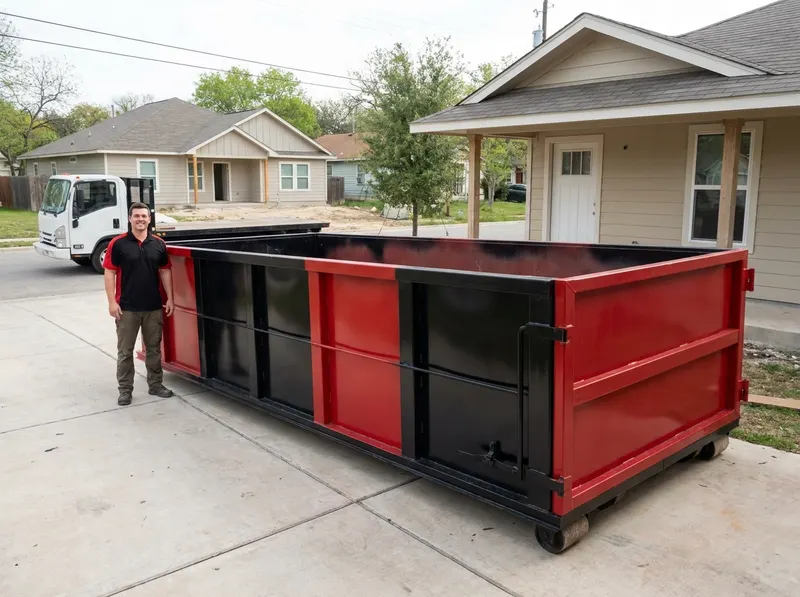
Commercial roll-off dumpsters manage the daily flow of discarded framing lumber, drywall cutoffs, packaging, and interior demolition scrap generated on Austin worksites. Projects operating along dense urban avenues like South Congress or narrow neighborhood job sites in Bouldin Creek and Hyde Park face tight access lanes where oversized industrial haulers risk blocking alleyways or crushing adjacent curb aprons. Selecting an appropriately sized roll-off container avoids active worksite clutter and keeps footpaths unobstructed around commercial remodels in mixed-use centers like Mueller or East Austin. Ground crews use protective timber buffers beneath the hydraulic roll-off rails and steel wheels, safeguarding poured concrete slabs and asphalt lots from surface fracture.
Matching the correct container capacity to the work scope prevents overfill fees and redundant haul trips. A 10-yard container holds approximately 3 to 4 pickup truck beds of dense material, making it the practical choice for restaurant interior updates, tile tear-outs, and small retail store fit-outs with strict staging footprints. A 20-yard container accommodates roughly 6 to 8 pickup loads, fitting larger commercial tenant-improvement projects, carpet extractions, and multi-room office renovations in office parks across Avery Ranch or Circle C Ranch. When managing extensive structural renovations, historic property updates in Tarrytown, or full commercial tear-outs near Zilker, a 30-yard or 40-yard container provides high-sidewall containment for bulky structural debris and large volume waste. The trade-off centers on spatial footprint versus capacity: a 40-yard container requires roughly 22 feet of clear length and overhead truck clearance, whereas a 10-yard container fits neatly into a standard commercial parking bay.
Waste disposal compliance in Travis County requires clear boundaries between general construction debris and regulated materials. Commercial roll-off containers are open-top bins loaded manually or via equipment on-site, differing from municipal scheduled trash compactors or full-service junk removal teams that hand-carry loose items out of buildings. Booking follows three straightforward steps: 1. Select the required container size based on estimated debris bulk, 2. Designate a firm, flat drop location clear of low power lines and tree canopies, and 3. Schedule the container retrieval as soon as work concludes to free up on-site operations.
Every job gets a firm, written price after a free on-site visit.
Tell us about your commercial dumpster rentals job in Austin and we'll send a clear, written quote, usually the same day.
 Silver Ridge Dumpster Rental